Housing
What Is ESA Compliance for Multifamily Housing Properties?
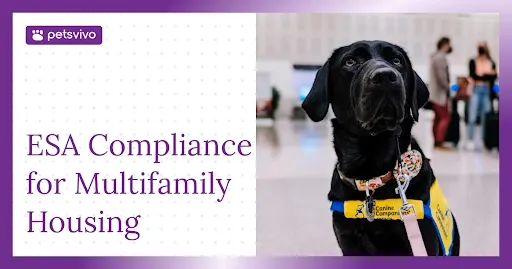
ESA compliance is one of the most misunderstood areas of property management in 2026, and getting it wrong is expensive. ESA accommodation requests have increased 34% since 2023, while 52.61% of all fair housing complaints now involve disability discrimination, according to HUD data cited by ESA Pet. For multifamily operators, that combination makes a documented, consistent ESA review process not optional. It is the baseline.
This guide covers what the law actually requires, what changed in 2025, how to verify documentation, and what operators cannot do under any circumstances.
What Is an Emotional Support Animal Under Federal Law?
An emotional support animal is a companion animal that provides comfort and therapeutic support to a person with a documented mental or emotional disability, and is legally classified as an assistance animal, not a pet, under the Fair Housing Act. This means your standard no-pet policies, breed restrictions, and pet fees do not apply to them. Unlike service animals, ESAs are not required to perform specific trained tasks. Their presence and companionship is the accommodation itself, and that distinction determines how every aspect of your policy must treat them.
What Did HUD’s September 2025 Guidance Withdrawal Change?
HUD withdrew its detailed ESA implementation guidance documents effective September 17, 2025, removing the specific instructions property managers had relied on to process accommodation requests, but it did not change the Fair Housing Act itself.
The legal obligation to accommodate ESAs remains fully intact. What changed is that operators can no longer rely on HUD’s published framework for how to evaluate requests. This makes your own internal documentation and consistency more important than ever, because without federal guidance as a reference point, your paper trail becomes your primary legal protection if a complaint is filed.
Which Properties Are Covered by the Fair Housing Act?
The Fair Housing Act applies to the vast majority of multifamily housing, including conventional apartments, condominiums, cooperatives, and federally assisted housing. If you manage a standard multifamily portfolio, you are covered without exception.
The narrow exemptions are: owner-occupied buildings with four or fewer units, single-family homes rented or sold without a real estate agent, and housing operated by religious organizations or private clubs for their own members. If your property does not fall into one of those categories, the Fair Housing Act applies, and ESA accommodation requests must be handled accordingly.
What Does a Valid ESA Letter Actually Require?
A valid ESA letter must come from a licensed mental health professional who has an established relationship with the tenant, and must demonstrate both that the tenant has a disability and that the ESA provides support related to that disability.
Generic letters purchased from online registries without any real clinical evaluation do not meet this standard. HUD has explicitly stated that documentation from websites that sell certificates to anyone who pays a fee is not sufficient to establish disability-related need.
ESA Letter Validity Checklist
| Element | What to Look For | Red Flags |
|---|---|---|
| Professional credentials | Licensed mental health professional licensed in the tenant’s state | No license number, no state listed, no letterhead |
| Therapeutic nexus | Establishes both a disability and a disability-related need | Generic language like “provides comfort” with no specific connection |
| Tenant specificity | References the specific tenant by name | Templated or fill-in-the-blank language |
| Provider contact | License number, type, provider name, and contact information | No way to independently verify the provider |
| Recency | Dated within the past 12 months | Undated or clearly outdated |
| Official letterhead | On the provider’s official letterhead | Consumer-facing PDF from a paid online registry |
What Can Property Managers Legally Do?
Property managers have specific, defined rights when reviewing ESA requests, and using them consistently is the foundation of a defensible compliance process. The key is applying the same standards to every request, documenting each step, and staying within the legal boundaries for verification.
Verify the Provider’s License
You can independently confirm that the mental health professional who signed the ESA letter holds an active license in the tenant’s state. State licensing board databases are publicly accessible, and most verifications take minutes. This is the single most effective step in identifying fraudulent submissions.
Ask Two Questions
The Fair Housing Act permits property managers to ask whether the tenant has a disability and whether the ESA is needed because of that disability. You cannot ask for the specific diagnosis, the nature of the disability, or access to any medical records.
Require Standard Animal Compliance
If your property requires current vaccinations or local licensing for all animals on-site, you can require this for ESAs as well. The requirement must apply uniformly to every animal, not selectively to ESAs.
Set a Consistent Response Timeline
Ten business days has become the industry standard response window for ESA accommodation requests. Treating it as your baseline is both reasonable and defensible, even following the HUD guidance withdrawal.
Evaluate Individual Animal Behavior
You can assess whether a specific ESA poses a direct, documented threat to the health or safety of others. This assessment must be based on evidence about that specific animal’s behavior, not assumptions based on breed.
What Property Managers Cannot Do?
There are four clear prohibitions that apply regardless of your pet policy, your lease language, or your insurance requirements. Violating any of them is a Fair Housing Act violation.
- Cannot charge pet fees. No pet deposit, no monthly pet rent, and no non-refundable pet fee apply to an ESA. Tenants remain liable for actual property damage, which can be recovered from the standard security deposit.
- Cannot apply breed or weight restrictions. Your restricted breed list does not apply to ESAs. Every animal must be evaluated individually based on documented behavior, not category.
- Cannot ask for medical records or a diagnosis. Requesting a tenant’s diagnosis, treatment history, or medical records is a violation. You can confirm disability and disability-related needs. Nothing beyond that.
- Cannot delay indefinitely. Failing to respond to an accommodation request in a timely manner is treated the same as a denial under fair housing law. Document your timeline for every request.
What Are the Penalties for Non-Compliance?
The financial consequences for Fair Housing Act violations are significant and increase with each repeated offense. First violations carry federal civil penalties of $20,114 to $25,000. A second violation within five years rises to $50,000 to $75,000. Three or more violations reach up to $100,571 per incident.
Beyond federal fines, landlords also face compensatory damages for emotional distress (typically $5,000 to $50,000 per case with no statutory cap), the tenant’s attorney fees if the case is won, mandatory fair housing training, and ongoing compliance monitoring. HUD enforcement actions increased 41% year-over-year in 2025, and average settlements run approximately $8,500 per case even before litigation.
How to Build a Defensible ESA Process
Consistency is the core of defensible compliance. Every request is handled identically, documented the same way, evaluated against the same criteria, and responded to within the same timeline. Properties that handle ESA requests through informal judgment calls are the ones that end up in fair housing disputes.
A defensible process includes:
- A written accommodation request form submitted by the tenant
- A verification checklist is applied to every submission
- A license verification step for every provider
- A documented decision with the basis recorded in writing
- A consistent response timeline is applied to all requests
- Written denials that cite only legally valid reasons
If a request is denied, the denial must be in writing, grounded in a legally valid reason, and free of any language that questions the disability itself. Seventeen states have now introduced penalties for tenants who knowingly submit fraudulent ESA documentation, which supports your right to verify. It does not reduce your obligation to process legitimate requests in good faith.
Conclusion
ESA compliance for multifamily properties comes down to three things: understanding what the Fair Housing Act requires, building a consistent verification process, and documenting every decision. HUD’s September 2025 guidance withdrawal created real uncertainty at the implementation level, but the legal obligation is unchanged. Operators who treat ESA requests as routine, apply the same process to every submission, and keep clear records are protected. Those who deny requests based on breed, charge pet fees for assistance animals, or skip verification are exposed to penalties that can reach six figures per violation.
Frequently Asked Questions
What is ESA compliance in multifamily housing?
It means following Fair Housing Act requirements when processing ESA accommodation requests, including proper verification, no pet fees, no breed restrictions, and documented responses.
Did HUD's September 2025 guidance withdrawal change what property managers must do?
No. The Fair Housing Act itself was not changed. The obligation to accommodate ESAs remains fully in force.
What can a property manager legally ask when reviewing an ESA request?
Property Managers can verify the provider's license and confirm that the letter establishes both a disability and a disability-related need. You cannot request a diagnosis or medical records.
Can a property manager charge pet fees for an ESA?
No. Pet deposits, pet rent, and non-refundable pet fees are all prohibited for ESAs under federal law.
What makes an ESA letter invalid?
No license number, no tenant-specific information, generic templated language, or documentation purchased from a paid online registry without a real clinical evaluation.
What are the penalties for denying a valid ESA request?
Federal civil penalties start at $20,114 to $25,000 for a first violation and reach up to $100,571 for repeat offenses, plus compensatory damages and attorney fees.