Hotels
What AI Search Reveals About How Travelers Research ESA Hotel Policies
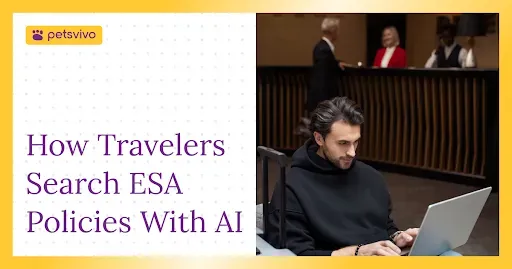
ESA compliance is no longer just a front desk problem. It is a discoverability problem. When a traveler with an emotional support animal plans a trip in 2026, they are not calling your front desk to ask about your policy. They are asking ChatGPT, Perplexity, or Google AI Overview. They are getting one answer, often before they have even decided which city to visit. If your hotel’s ESA and pet policy content cannot be read, understood, and cited by those AI systems, you are being filtered out of a booking decision before the guest ever encounters your property.
This post covers what AI search behavior around ESA hotel policies actually looks like, what travelers are asking, and what the data reveals about which hotels are showing up in those answers and which ones are not.
How Travelers Are Now Researching Hotel ESA Policies
The research behavior of pet-traveling guests has shifted decisively toward conversational AI queries. Where guests once typed “pet-friendly hotels in Denver” into Google and scrolled through results, they are now asking AI systems questions like “which hotels in Denver allow large dogs,” “do pet-friendly hotels in Austin accommodate emotional support animals,” and “what hotels near downtown Nashville allow dogs with no weight limit.” These are not keyword searches. They are natural language questions that expect direct, specific answers.
According to a 2025 global study by Cloudbeds, nearly 30% of travelers have already used AI to plan a trip, and 84% say it enhanced their experience. The same study found that AI-driven traffic to U.S. travel and hospitality sites surged 1,700% between July 2023 and February 2024. The travelers asking these questions are not a niche segment. They are increasingly mainstream, and their expectations are shaped by AI that gives direct answers rather than lists of links.
For ESA-specific hotel queries, the stakes are higher than for generic pet queries. Guests traveling with ESAs often have specific questions about documentation, fees, access, and whether the property understands the legal distinction between ESAs and service animals. These are high-intent, high-specificity questions that AI can only answer if your hotel has published clear, structured content that addresses them.
What AI Looks for When Answering ESA Hotel Policy Questions
AI answer engines do not guess. They pull from sources. When a traveler asks an AI system about a hotel’s ESA policy, the system searches for available structured content across your website, OTA listings, review platforms, and third-party directories. What it finds, and how clearly it is written, determines whether your property appears in the answer, appears with accurate information, or does not appear at all.
The Cloudbeds study found that 55.3% of all citations in AI hotel recommendations came from OTAs, making them the single most cited source type. Hotel websites accounted for 13.6% of citations, well above the industry average across other sectors. Travel blogs, community forums like Reddit, and review platforms made up most of the remainder.
For ESA-specific policy queries, this citation mix has a direct implication: if your OTA listing says “pet-friendly” without specifying whether ESAs are accepted, what fees apply, and what documentation is expected, AI has nothing specific to cite. It either skips your property or, worse, cites incomplete information that creates incorrect guest expectations.
The Long-Tail Query Problem Hotels Are Ignoring
One of the most significant findings from recent hospitality AI research is the growing importance of long-tail, high-intent queries. Sanjay Vakil, CEO of DirectBooker and a PhocusWire Hot 25 Travel Startup for 2026, made the point directly: “Someone may want to know whether the hotel’s pet policy has a weight limit. That is a reasonable question.”
He recommended that hotels stop treating specific policy questions as too niche to answer in detail, and instead recognize that long-tail queries from AI users are high-intent booking signals. A traveler asking whether a hotel accepts large ESAs is not browsing. They are deciding.
The ESA policy questions travelers are asking AI in 2026 include: “Does this hotel charge fees for emotional support animals?” Does presenting an ESA letter waive the pet fee at hotels? What hotels accept emotional support animals without breed restrictions, and can I bring my ESA to a hotel that does not allow pets?
These are specific, answerable questions. Hotels that publish specific, answerable content about their ESA policies are the ones that appear in those AI responses.
ESA-Related Hotel Queries Travelers Are Asking AI
Travelers are using AI for their searches because it helps them get targeted results that meet their exact requirements. As a result, if your hotel is invisible to AI search engines, you are missing out on the next generation of search tools.
Here are some examples of what people are searching for:
| Query Type | Example Query | What AI Needs to Answer It |
|---|---|---|
| Fee inquiry | “Do pet-friendly hotels charge ESA fees?” | Clear fee policy on website and OTA listings |
| Access inquiry | “Can I bring my ESA to a no-pet hotel?” | Plain-text policy stating the hotel’s ESA position |
| Legal inquiry | “Does my ESA letter give me rights at hotels?” | Educational content explaining FHA vs ADA hotel rules |
| Specific property | “Does [Hotel Name] accept emotional support animals?” | OTA listing with explicit ESA policy detail |
| Service animal distinction | “What is the difference between an ESA and a service animal at hotels?” | Dedicated policy page or FAQ content on website |
| Extended stay | “Do extended stay hotels have to accept ESAs?” | Content addressing the 30-night FHA threshold |
Why Most Hotel ESA Policy Content Is Invisible to AI
Despite the volume of ESA-related hotel queries entering AI systems daily, most hotel ESA policy content is effectively invisible to AI engines. The reason is structural, not intentional.
Most hotels address pet and animal policies in one of three ways that AI cannot read effectively: a general “pets welcome” tag on an OTA listing with no detail, a pet policy buried in a PDF or a terms and conditions document that AI cannot parse, or a brief mention in the booking confirmation that guests only see after they have already committed to the property. None of these formats gives AI the structured, specific, plain-text content it needs to cite your property in response to a specific policy question.
By contrast, the properties that appear consistently in AI responses to ESA and pet policy queries share a set of characteristics: plain-text pet policy pages on their own websites that answer specific questions about fees, breeds, documentation, and access; OTA listings with explicit pet policy fields completed in full; and third-party coverage from directories and travel blogs that mention specific policy details rather than generic pet-friendliness.
The content surfacing in AI results, as described in recent hospitality industry analysis, comes almost entirely from structured markup and plain-text content, not from the marketing copy that many hotel websites have relied on for years. Every policy detail matters. Every amenity specification matters. Every documented rule about pets and animals needs to be published in a format that AI can read, extract, and cite.
The Visibility Gap Between ESA Compliance and AI Discovery
There is a direct relationship between ESA compliance quality and AI discoverability that most hotel operators have not yet made explicit. A hotel that has invested in a written ESA and service animal policy, trained its staff on the ADA two-question protocol, and documented the distinction between ESAs and service animals in a clear, accessible format has already done the content work that AI needs to surface that property in relevant queries. The compliance content and the discoverability content are the same content.
A hotel’s FAQ section that explains whether ESAs are accepted, what documentation is requested, what fees apply, and how service animals are handled differently from ESAs is simultaneously a compliance resource for staff, a guest expectation management tool, and a structured content source for AI systems to pull from when travelers ask those exact questions.
The hotel that has published that content in plain, crawlable HTML is answering thousands of pre-booking questions without any staff involvement, and it is appearing in AI recommendations that competitors with identical pet policies but no accessible policy content are being excluded from.
This is what AI search reveals most clearly about how travelers research ESA hotel policies: the hotels that answer the question before it is asked are the ones that get the booking. The hotels that require the guest to call, email, or rely on a front desk conversation to understand the policy are the ones being filtered out of AI recommendations before that conversation ever happens.
What Structured ESA Policy Content Looks Like in Practice
The practical difference between content that AI can cite and content that it cannot is not complex. It comes down to whether the information exists in a format the AI can read and whether it is specific enough to actually answer a question.
Content AI can use:
- A dedicated pet policy page with specific fee amounts, accepted species, size, and breed information, and documentation expectations written in plain HTML
- An FAQ section that directly answers questions about ESA acceptance, service animal accommodation, and the difference between the two
- OTA listings with all pet policy fields completed, including whether ESAs are accepted under the standard pet policy and what fees apply
- Review responses from management that mention the pet policy in natural language, because AI processes response language as part of its content assessment
Content AI cannot effectively use:
- A PDF document titled “Pet Policy” that is linked from a booking confirmation
- A checkbox on an OTA listing that says “pets allowed” with no further details
- A note on the reservation confirmation that arrives after the booking is made
- A policy that exists in the property management system but is not published anywhere publicly accessible
What This Means for How Hotels Should Think About ESA Policy Content
The implication of how AI researches and surfaces ESA hotel policy information is that policy content is no longer a back-office document. It is a front-of-house marketing asset. A hotel that publishes specific, clear, accessible ESA and pet policy content is not just managing compliance. It is competing for visibility in the AI recommendation layer that now precedes most booking decisions for high-intent travelers.
The travelers asking AI about ESA hotel policies are not casual browsers. They are deciding. They have a specific need, a specific animal, and a specific question that your property either answers or does not. By 2026, a meaningful share of booking activity is being initiated, filtered, or assisted by AI agents acting on travelers’ behalf. Those agents, as noted by Hotel Online’s hospitality industry analysis, prefer properties that make decision-making easy. They avoid properties that require interpretation. If something is unclear, that guest never arrives.
For pet-friendly hotels, the clearest path to inclusion in the AI recommendation layer for ESA-related queries is the same path that yields better compliance outcomes, fewer front desk disputes, and stronger guest reviews.
Publish specific, plain-text policy content. Answer the questions travelers are asking of AI before they have to. Make the policy findable, readable, and citable. The hotels that do this will appear in AI answers. The ones that do will not.
Conclusion
AI search has made ESA’s hotel policy content a competitive asset in a way that was not true three years ago. Travelers researching ESA accommodation before booking are asking highly specific questions that AI can only answer using structured, accessible content from hotel websites, OTA listings, and third-party sources.
Hotels that have invested in clear ESA and pet policy content are being surfaced in those answers. Hotels that have buried their policy in PDFs, left OTA pet fields incomplete, or rely on front desk conversations to communicate policy are invisible in the AI discovery layer. The compliance work and the visibility work point to the same output: specific, public, plain-text policy content that AI can read and travelers can trust.
Frequently Asked Questions
What kind of ESA hotel policy questions are travelers asking AI?
Travelers are asking whether ESA letters waive pet fees at hotels, whether no-pet hotels must accept ESAs, the difference between ESA and service-animal hotel rights, and whether specific properties accommodate emotional support animals.
Why does ESA policy content matter for AI hotel visibility?
AI answer engines pull structured, accessible content to answer travelers' questions. Hotels without plain-text ESA policy content on their websites and in their OTA listings cannot be cited in AI responses, even if their actual policy is strong.
What content format does AI need to cite hotel ESA policies?
Plain HTML text on a dedicated pet policy or FAQ page, completed OTA pet policy fields, and clear management responses to reviews mentioning pets. PDFs and policy buried in booking confirmations are not readable by AI.
Are ESA hotel policy queries high-intent booking signals?
Yes. A traveler asking AI whether a specific hotel accepts their ESA is typically making a decision, not browsing. Appearing in that AI response is functionally equivalent to winning a direct booking inquiry.
Does publishing clear ESA policy content help with both compliance and visibility?
Yes. A well-written, accessible ESA and service animal policy page simultaneously reduces front desk disputes, manages guest expectations, and provides AI-readable content that improves discoverability for pet-traveling guests.
How does the Cloudbeds research connect to ESA policy visibility?
The Cloudbeds study found that every AI-recommended hotel had clear, consistent content across its website and OTA listings. Properties that answered specific guest questions in accessible formats were consistently more visible in AI recommendations than those that did not.